Sustainability regulation
Omnibus dust has settled. Here’s what companies inside and outside of scope should do next.
The recently proposed Omnibus changes to CSRD have caused quite a stir in the sustainability circles. One thing remains clear: the impacts businesses cause, and the sustainability-related risks and opportunities they face, have gone nowhere. - So, what should companies do next? Based on our conversations with our CSRD customers and investors, here’s our recommendations for different-sized companies.
Published Mar 18, 2025
1. With or without Omnibus, you have to understand sustainability-related impacts, risks, and opportunities.
Even with the regulatory changes, the impacts, risks, and opportunities that companies face remain as urgent as ever. Investors, customers, employees, and other key stakeholders (often more influential than regulators) will demand transparency and comparable sustainability information.
With or without Omnibus, companies that understand and address their most significant impacts, risks, and opportunities – especially those that can translate them into financial terms – will have a competitive edge in attracting talent, capital, and customers.
Double Materiality remains *the* framework for sustainability strategy
Double materiality assessment has established its role as the foundation of continuous sustainability strategy work.
Many companies have already incorporated DMA into their sustainability work, recognising its value beyond regulatory compliance. At Upright, we’re witnessing a lot of companies proceeding with their DMA work even if they may fall outside of CSRD reporting requirements in the future.
Most companies see DMA as the foundation for their sustainability strategy, focusing on business upside rather than mere compliance.
2. In a positive shift, there will be less time spent on reporting, more time on what matters most.
One silver lining of the Omnibus adjustments is that companies may now have more flexibility to concentrate on what drives actual impact. Instead of being burdened with reporting hundreds of data points, businesses can redirect their efforts toward:
- Identifying and understanding their most significant sustainability impacts, risks, and opportunities (IROs).
- Taking concrete actions to mitigate sustainability-related risks and negative impacts and act on opportunities and generate positive impacts.
- Leveraging sustainability data to create strategic insights for finance teams by translating risks and opportunities into monetary effects on key financial values (see example of how to do this here).
This shift allows for a more meaningful approach to sustainability, one that goes beyond compliance and contributes to long-term value creation.
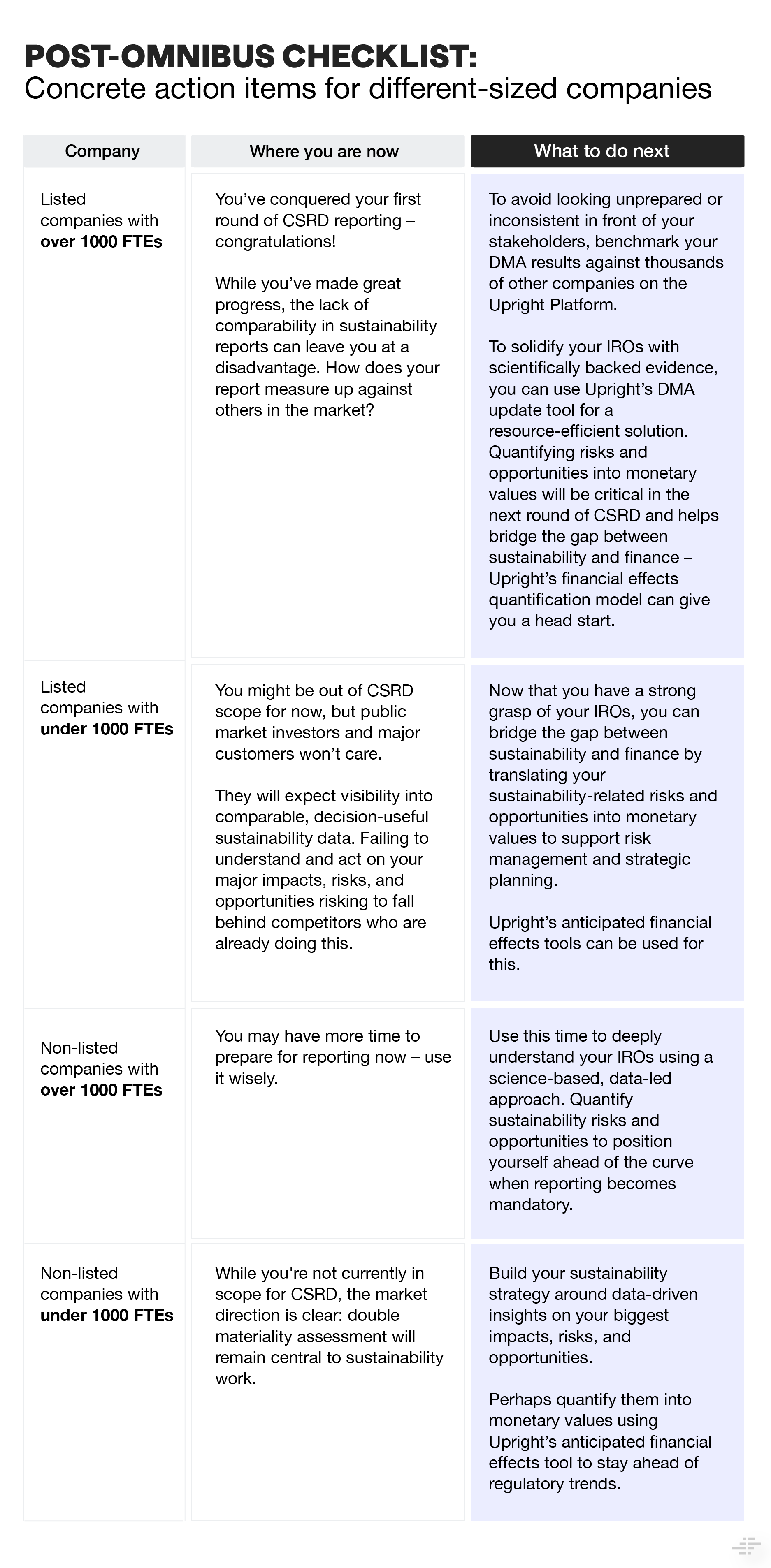
3. Post-Omnibus checklist: concrete action items for different-sized companies
To keep things simple, below is Upright’s take on what we think companies of different sizes should focus on in the upcoming months.
4. A note on investors: They now prefer companies that understand the financial reality of sustainability, don’t just report on it.
At Upright, we've seen leading investors adopt CSRD as a primary sustainability framework for analysing portfolio sustainability. But what will they demand now that about 80% of companies fall outside of the original CSRD scope?
Investors are now looking for alternative sources of comparable, decision-useful sustainability data, which is where third-party providers with automated, science-based tools come in. Investors will increasingly look for companies that not only report but actively manage their sustainability-related risks and opportunities.
Here, smaller companies risk falling behind unless they leverage data-driven insights, while larger companies that excel in sustainability reporting and strategy will have a competitive edge in attracting capital (and customers and talent).
Want more actionable insights? Join our webinar!
To further explore the implications of Omnibus, we are hosting a webinar: "Implications for Companies: Increased Competitiveness or Weakened Sustainability?" on Thursday, March 20th, from 13:00 - 14:00 CET.
Want to discuss how your company can conduct an efficient, science-based, and data-led double materiality assessment?
Let’s talk – book a demo.
March 18th, 2025
Upright Project
Share: