WANTED:
COMMON-SENSE
IMPACT DATA
TO BRING FOCUS
(BACK) TO WHERE
IT SHOULD BE.
WANTED:
COMMON-
SENSE IM
PACT DATA
TO
BRING FO
CUS (BACK) TO
WHERE IT
SHOULD BE.
Upright's mission is to equip companies' stakeholders with high-quality impact data – to help them see the forest from the trees in the increasingly overwhelming sustainability discussion.
After all, it's the investors, customers, employees, and other stakeholders who ultimately vote with their money, talent, and decision-making power – and determine which companies win in global competition.
What's the end game? To make it *financially* more attractive to run a net positive company than a net negative one.
HOW DOES UPRIGHT PURSUE ITS MISSION?
COMPANIES
IMPACT THE WORLD
AROUND THEM
MORE THAN EVER.
BUT HOW?
From what we eat and drink, to how we communicate, learn, and move around, companies’ impact on human lives and the planet has never been more significant. In today’s global economy, companies play a pivotal role in virtually every major event and phenomenon – both in causing and solving problems.
But what do we really know about the impact of companies on the world around them?
What's the impact of






























?
What's the impact of
?
ESG TO THE RESCUE!
RIGHT?
WRONG.
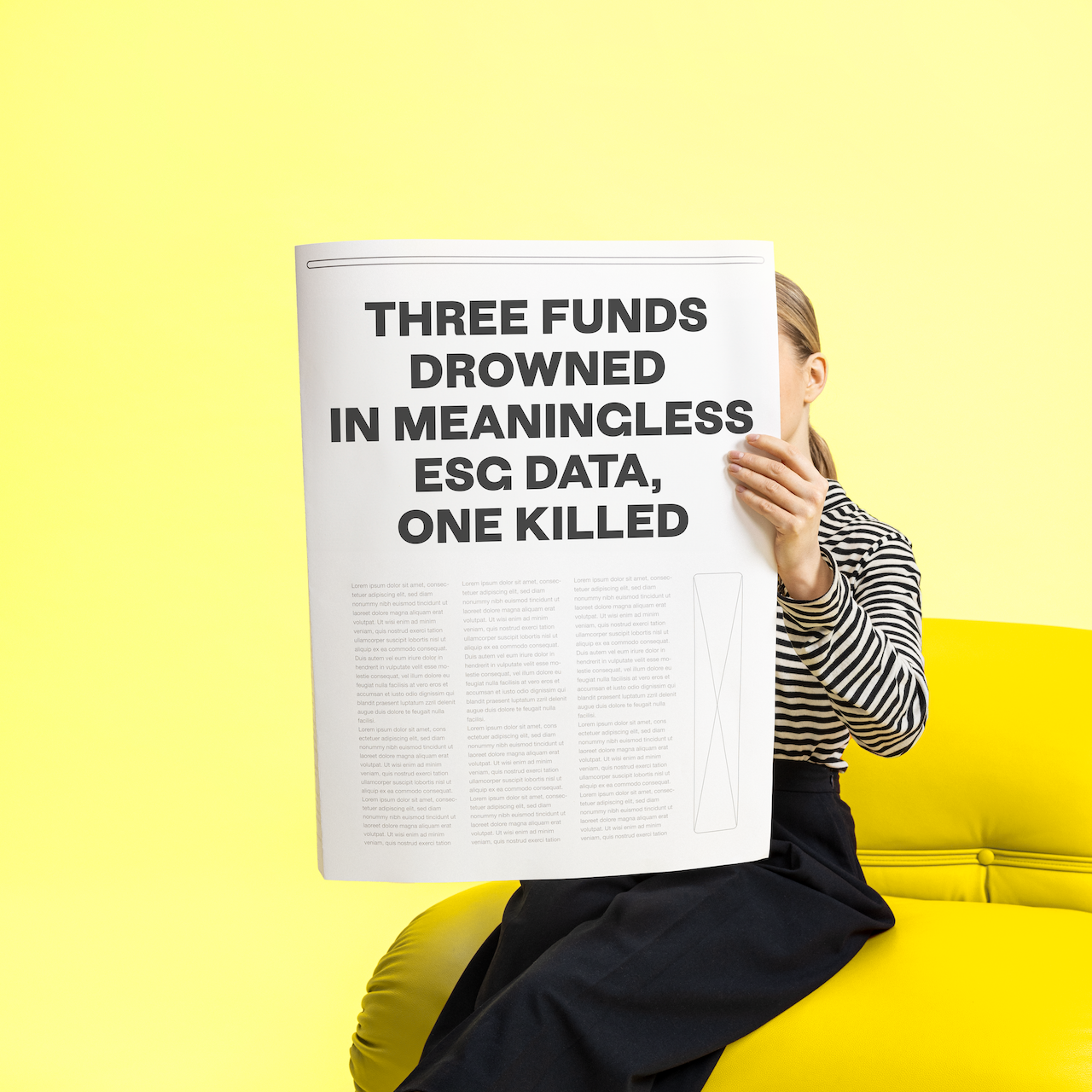
Unfortunately, traditional sustainability and ESG data does little to address this existential question. While describing “how” a company does what it does (how diligent sustainability reporting does a company produce, what kinds of processes are in place) – traditional sustainability data says little about the “what”: what is the overall impact of a company on the surrounding world.
The current metrics lack in four fundamental ways:
4 reasons why current sustainability/ESG data is not enough
+
Confusing big and small things
+
Measuring reporting diligence (rather than the actual business impact)
+
Derailing focus away from the core business i.e. the products the company sells
+
Full of jargon and unnecessarily complicated frameworks
WHAT THEN?
The missing piece in
today’s sustainability
discussion
So if the traditional sustainability metrics are not quite doing the trick, what is needed then? The crucial missing piece in today’s sustainability discussion is proper understanding of *how a company uses and creates value: as a whole, does it cause more good than harm for the surrounding world*.
Difficult and complex to define, let alone calculate? Yes. Absolutely crucial for the future of the capitalistic system? You bet.
Determining a company’s net impact requires quantifying both the largest positive and negative impacts of its core business. This is not a question of corporate behaviour or compliance. This is about what resources companies use, what is the quantity of such use – and what value do the companies succeed in creating with said resource use.
Upright aims to show that quantifications of companies’ net impact both can and should be produced, and has set itself the following ambitious task:
The
The challenge Upright has set for itself
When Upright was founded, the team made a list of design criteria for their ridiculously ambitious model: what it would take to fundamentally transform the discussion on company impact. This list still guides our work every day – and explains why we do what we do.
Science-dictated1:
QUITE A
REQUIREMENT LIST!
SO WHAT DOES THE
MODEL ACTUALLY DO?
For the past 6 years, Upright has been building a data model that fills the above listed criteria. To explain how the model works, let’s start by outlining the main question it seeks to answer.
The Upright net impact model addresses the mind-boggling question: If all negative and positive “impacts” born in the global economy were allocated across all companies in the world, what would each company’s share of the impacts and resulting value creation profile look like?
To answer the question, Upright has built a unique knowledge graph of the global economy – one that consists of all the products and services that are currently produced and sold in the global markets. This graph entails information of not just all the products and their production volumes, but also the various value chain dynamics across the global private sector. This value chain information is crucial for being able to understand how companies are linked to one another in the increasingly connected global economy. This product graph serves as the basis of the Upright model, also when it is used to produce e.g. CSRD double materiality assessment data or information about how companies’ core business is aligned with the United Nations Sustainable Development Goals.
The product graph is constantly developing as new products are invented every day and value chain dynamics change. For example, when a new artificial sweetener is introduced to the market, a new branch of soft drinks, candy, and other products sweetened with it is born in the graph. Information about these new innovations are integrated to the model either via the addition of new funds and companies to the Upright database through our customer work, or through the integration of new databases into the model.
After the graph of products and services has been formed, the model faces the task of estimating how different impacts “flow” across it. An important requirement of the model here is that no double-counting is allowed to occur. This means that the Upright net impact model simulates the world’s impact flows in a way where each unit of “impact” – be it emissions, waste, health outcomes, tax dollars, or something else – is allocated once and only once.
To achieve this, the Upright model allocates the global total of each impact category into the product graph. For example, the model takes the total of CO2e emissions that organisations like the IPCC estimate to be caused by the global private sector annually and allocates the total into the whole network of products, considering value chain relations between companies and production volumes flowing from each node to another. This way, the CO2e emission figures of all companies in the world sum up to the global total – not more and not less.
Given that the question spans over the entire value creation spectrum of companies, it is important to not limit the data to what companies themselves are already reporting. Thus the primary data source for impact information is science, and in particular the world’s largest open-access database CORE. Upright has developed various means to read scientific publications by machine, summarise their findings, and link them to the product graph. Company reports, when available, are primarily only used for financials and more detailed information about products and their production methods.
Essentially, Upright aims to put the best available scientific knowledge to work in order to form a better understanding of how all the companies in the world together cause the global impacts we witness – be it CO2 emissions, biodiversity loss, plastics in the oceans, tobacco-related lung diseases, overweight populations, or fake news.
Finally, once this procedure is completed, it is time to build profiles for companies. Compared to everything that has happened before, this process is fairly straightforward: the Upright model matches companies against the product graph and weighs each product’s net impact profile with its corresponding revenue contribution. To produce profiles for funds (or any other groups of companies), company profiles are brought together and weighed with the appropriate weight factor, e.g. the dollar amount of funds invested. This modular way of forming product, company, fund, and portfolio profiles makes the Upright model fairly unique, as it allows for comparisons regardless of asset class, reporting structures, legal entity, and other differentiating factors.
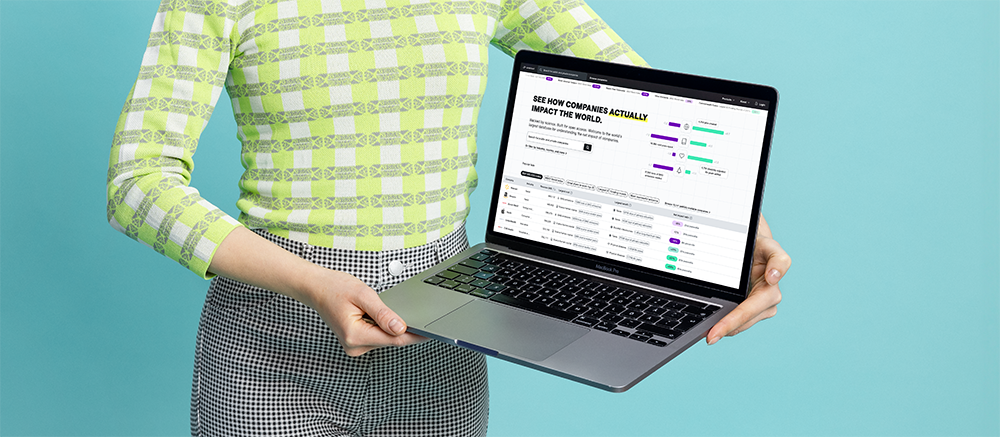
To understand what the model looks like in practice, we recommend exploring concrete impact profiles of companies on the open Upright Platform. Take a look at Siemens, Tesla, or Pfizer, for example! For more information on Upright’s methodologies and technologies, visit Upright’s open-for-all Knowledge Base.
FAQ
+
Why does Upright share its data for free? What's the catch?
+
What's the business model? Why would customers pay for the data if you give it out for free?
+
Who owns Upright?
+
Do you update the model and the data it is based on? If so, how?
+
How do you test the quality of the model's data?
+
Doesn't showing the positive impacts risk greenwashing and downplaying the negative impacts?