Data-driven CSRD double materiality for asset managers











Upright's approach to double materiality
The Upright approach to double materiality combines rigorous science-based analysis with stakeholder views to yield a uniquely robust assessment of double materiality.
The science-based analysis is provided by the Upright data engine, which integrates information from a variety of sources, including 300M+ scientific articles, public databases, and information supplied directly by the company.
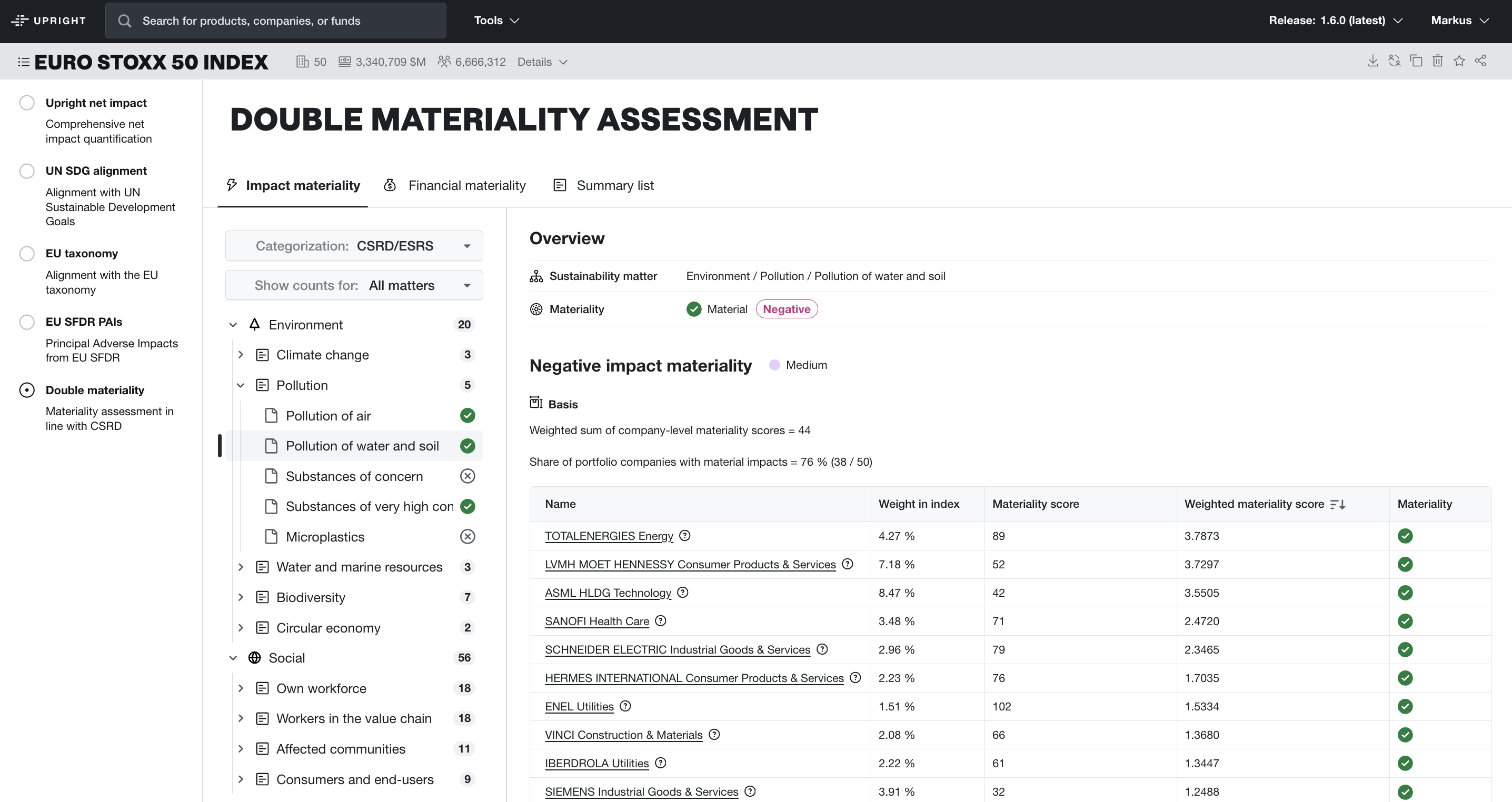
For asset managers, Upright's approach covers both the financial company and the investment portfolio on the level of individual holdings, enabling robust data-driven assessment of the full value chain.
Value chain assessed on holdings-level across the investment portfolio
Highly efficient process
Uniquely robust, easily auditable results
Upright's 5-step double materiality assessment process
Own operations
1Input data
The investor submits a breakdown of its business lines, including sizes in revenues, additional data points, and geographical data to Upright.
2Science-based analysis
The Upright data engine identifies material impacts, risks, and opportunities across sustainability matters based on the investor’s input data and by integrating information from e.g., 300M+ scientific articles and public databases.
3Stakeholder surveys
Relevant stakeholders are surveyed across sustainability matters. Upright provides the list of potential stakeholder groups to be surveyed and the survey questionnaires, and analyzes the results.
4Integration
Upright analyzes the differences between the views gathered by stakeholder engagement and the science-based analysis, gathering additional data when needed, until all differences can be satisfactorily explained.
5Delivery
Upright delivers the final results to the investor. Results are provided both via the Upright Platform and in excel format.
Portfolios
1Input data
The investor submits portfolio holdings information to Upright.
2Science-based analysis
[Same as above, but for each portfolio holding individually.]
3Stakeholder surveys
(Not applicable)
4Integration
(Not applicable)
5Delivery
Upright delivers access to portfolio-level DMA results. Portfolio assessment is integrated with investor’s own operations.
Deliverables
Final report with both impact and financial materiality status for all ESRS topics and relevant entity-specific topics, along with the following information:
- Severity of impact
- Impact valence (positive / negative)
- Impact type (actual / potential)
- Relevant value chains (upstream, downstream, internal)
- Relevant time horizons (short-, medium- and long-term)
- Thresholds used for defining impact and financial materiality
- List of relevant risks and opportunities, including risk magnitude and probability
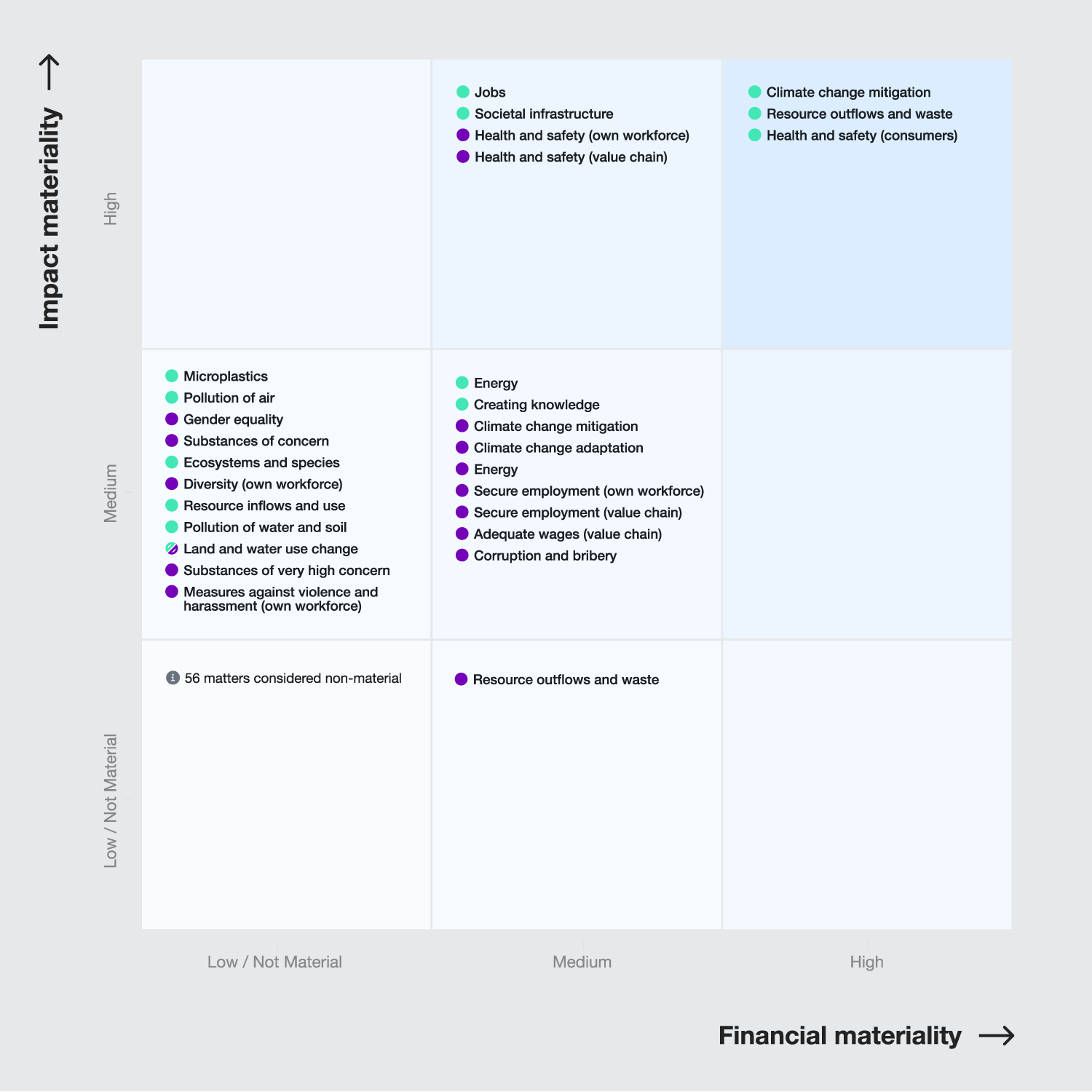
Visual representation of material sustainability matters in the form of a materiality matrix
Report on the methodology for assurance purposes
List of relevant ESRS disclosure requirements based on the results
Upright Publishes Live CSRD Double Materiality Quantification of 50,000+ Companies
Access our 60-minute webinar to learn about Upright's novel double materiality database covering 50,000+ companies, and its benefits for financial institutions and corporations. In the webinar, our experts will showcase Upright's double materiality database in full depth, discuss the unprecedented use cases for both financial institutions and corporations, and dive into the quantification model methodology.
In this webinar you will learn about:
- How can financial institutions benefit from fully comparable and granular double materiality data in portfolio screening and CSRD compliance at scale?
- How can corporations benefit from science-backed double materiality data and benchmarking against 50,000+ companies' impacts, risks and opportunities?
- How does Upright's model quantify companies' material risks and opportunities, based on nearly a decade of impact quantification expertise?
Access the webinar recording:
Expert speakers:




Science-based double materiality assessment gives an external point of view without any emotional bonds or personal opinions. We can start the validation process with stakeholders now with objective data.