Measuring impact
5 key insights from analyzing the net impact of COP28 sponsors
How do companies sponsoring COP28 actually impact the world? Upright analyzed them for their science-based net impact. Here are 5 key insights looking behind the green curtain of the largest COP in history.
Published Dec 11, 2023
Companies sponsoring the COP28 in the UAE have faced intense scrutiny related to their sustainability and fossil fuel ties. But behind speculation, what can we actually know about their impact on the world?
Upright analyzed the sponsors for their science-based net impact – the sum of a company’s positive and negative impacts on people, society, and the planet – to find out what costs and benefits they actually bring to the world. Here are 5 key insights looking behind the green curtain of the largest COP in history.

1. The big picture: most COP28 sponsors are not solving the world's biggest problems
The big picture of COP28 sponsors is that while there are only a handful of net negative companies involved, the vast majority of the sponsors do not have a significantly net positive impact on the world. This means that most COP28 sponsors are not actively solving the biggest issues of our time.
2. Environmental forerunners are a rare breed
Perhaps surprisingly for a climate action conference, only four sponsoring companies have a significantly positive impact on the environment. These are all companies related to the production of renewable energy, including:
- Masdar, a UAE renewable energy company
- Korea Hydro & Nuclear Power, a South-Korean nuclear and hydroelectric operator
- Octopus Energy, the UK renewable energy group
- Iberdrola, the Spanish multinational electric utility (Note: While Iberdrola still engages in fossil fuel-related activities, according to their sustainability report, approximately 78% of their own electricity production is associated with emission-free technologies)
3. A third of sponsors are financial institutions – and their true impact is more complex than what one might think
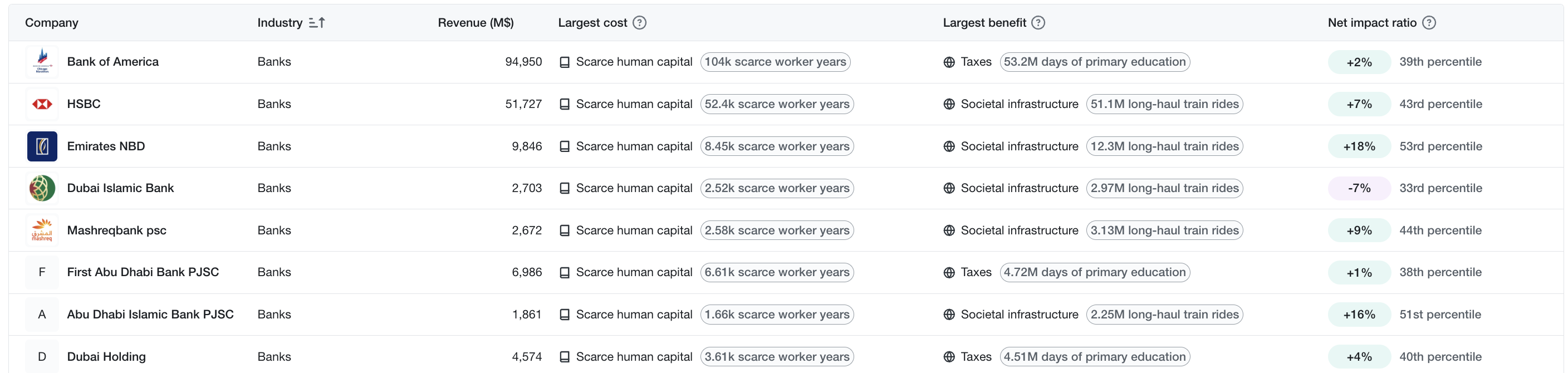
Around one-third of the sponsoring companies this year are banks or investors, including e.g. Investcorp and HSBC.
While financial institutions are often considered “good” companies in terms of impact, as they have limited direct environmental impacts, it is time we start looking closer at their actual asset management profile – specifically, the activities they finance. Through this, their operations can have substantial impacts, either negative or positive, on issues like climate change. Transparency remains a persistent challenge in this regard.
4. The most net negative sponsor is a leading oil field services company
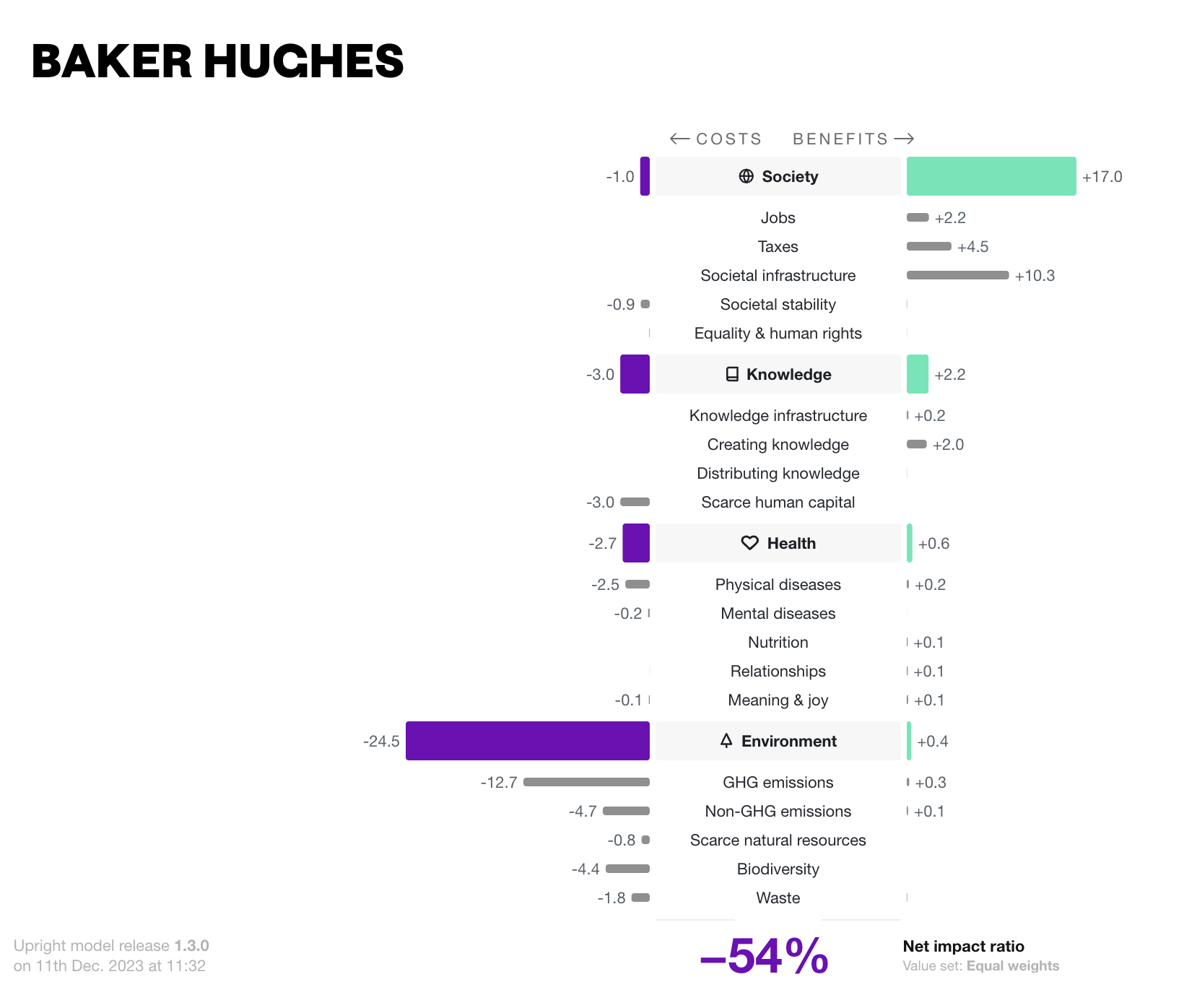
Baker Hughes, one of the world's largest oil field services companies, is the most net negative sponsor of 2023 due to its significant environmental impacts, especially on GHG and non-GHG emissions and biodiversity.
While the company says they are growing their climate tech -related solutions, a vast majority of their core business is still linked to the oil and natural gas industry.
Moreover, while the company has reported cutting emissions from its operating facilities, their actual impact on the world is driven largely by manufacturing equipment for oil and gas production and distribution for others. This is a clear example of how incrementally tweaking what happens in a company’s own operations is often not enough to change the biggest impacts from the value chain.
Moving forward, it’s important to acknowledge the potential role that Baker Hughes might play in enabling the green transition through its technologies, as has been publicly discussed e.g. in Forbes. In a broader sense, it's best not to adopt a simplistic view of categorizing companies as purely "good" or "bad," but instead assess whether they consistently align their actions with their stated commitments over time.
5. Siemens highlights why it’s not enough to just look at CO2 emissions
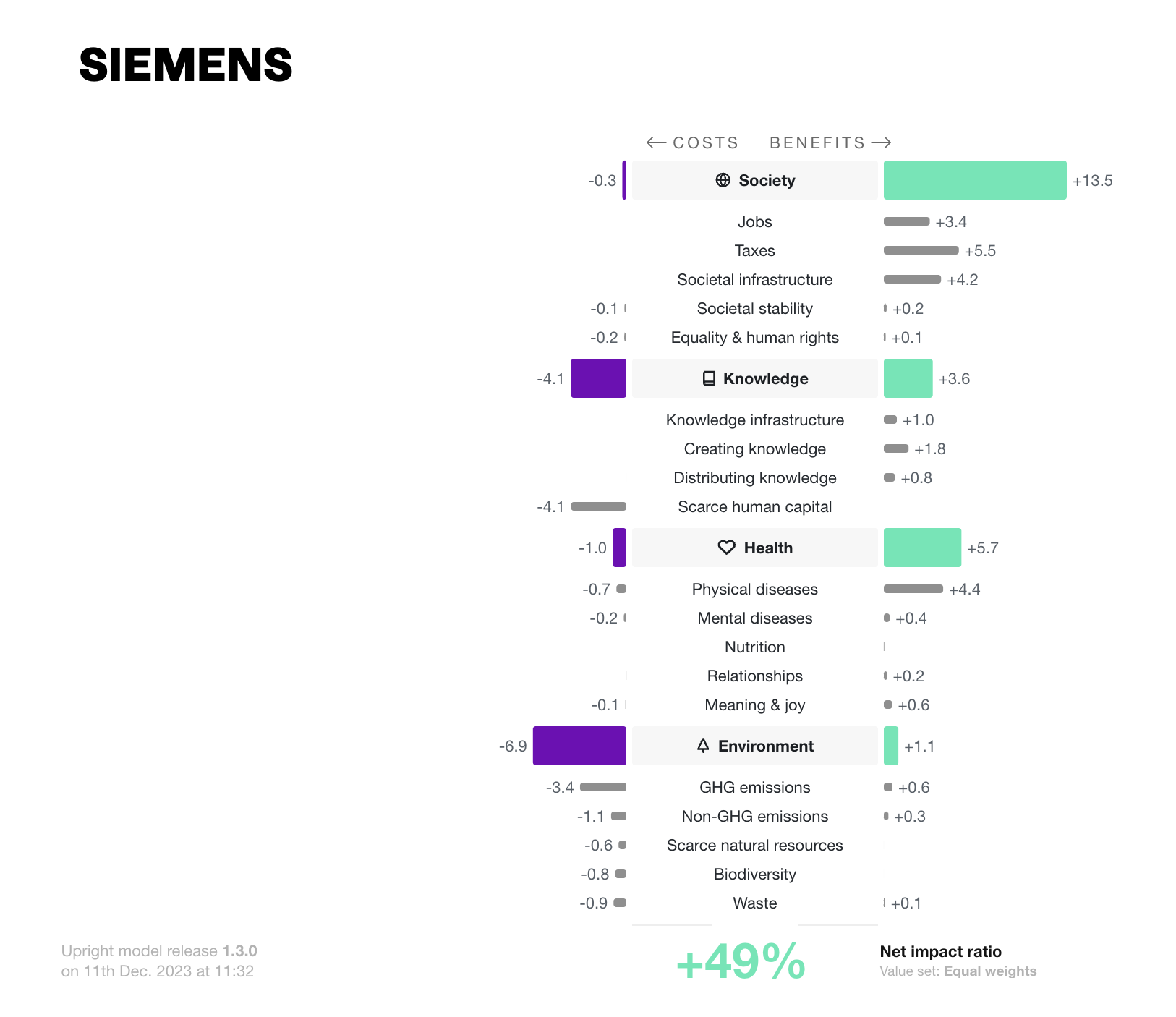
Siemens is one of the sponsors bringing the most benefits to the world through its core business. Siemens’s high net impact is driven especially by its positive impact on human health through health-related technology, as well as building societal infrastructure. The company’s product portfolio also includes products to support decarbonization efforts.
In general, Siemens is an example of how only looking at a company's CO2 emissions is not enough to understand their impact on the world. Instead, we need to look at the whole value creation spectrum, including negative and positive impacts, on people, society, and the planet.
Conclusions – What should we think about COP28 sponsors, then?
As sustainability discussions intensify, it is crucial to move beyond simplistic classifications of companies as “good” or “bad,” as well as only looking at companies’ direct CO2 emissions. Neither approach gets the global sustainability discussion very far.
“The conversations around COP28 sponsors are helpful if and only if they bring the largest impacts of businesses to the spotlight. Otherwise they run the risk of becoming just another coffee club observing the world collapse around it,” says Upright’s founder & CEO Annu Nieminen.
What should the next COP sponsor discussion be about, then?
Large transformations that entire industries, not just individual companies, face. How humanity cannot afford to use resources for all the things we used to use resources for. How we need a better understanding of the impact of different CO2 emission-causing activities – as we simply cannot afford to do everything we used to.
That’s the way forward.
Explore the science-based impact of COP 28 sponsors on the Upright Platform!
December 11th, 2023
Upright Project
Share: