Big ideas
Why I decided to join Upright as an investor
In this post, Upright’s advisor and investor Risto Siilasmaa shares why he thinks we need new metrics for net value creation of companies.
Risto Siilasmaa
Chairman, Nokia and F-Secure & Advisor and investor, Upright
Published Oct 22, 2019
Like many entrepreneurs, I am a bit impatient. I would like to get results quickly and hate false barriers to creating the desired impact. Like many of you, I grow frustrated when people focus on the appearance of action without any real intention of getting the job done. These types of charades are, of course, quite commonplace in politics, but also in the corporate world.
One area where this type of play acting is highly prevalent in the world of business is Corporate Social Responsibility (CSR), where companies are trying to reduce the harm their operations impose on the environment and stakeholders, and some investors are aiming to create portfolios that could be marketed as ethical.
Don’t misunderstand me. I am not claiming that CSR work would not be valuable, nor am I saying that companies would not take it seriously. My sense of frustration is that CSR often ignores the vast majority of the company’s real impact as it only focuses on discussing how well the business has been able to reduce the harm it causes as a side effect of its operations — ignoring what the impact of the actual intended output is. In other words, the harm caused via the activity is not weighed against the value created.
Traditional approach is not enough
Another challenge that this traditional approach has is that it does not distribute the harmful side effects in a fair way. Let’s take steel manufacturing as an example. How do you take into account the pollution caused by steel manufacturing, if your business is downstream from steel manufacturers. How accurately can the pollution created be allocated downstream to the projects that actually use the steel?
There are other challenges as well. I once talked with the chairman of one of the world’s largest steel companies. He told me that they had sold their oldest and most polluting factory to a competitor. This significantly decreased their negative impact, but did not change things from the environment’s point of view. The old factory pollutes just as much with the new owner.
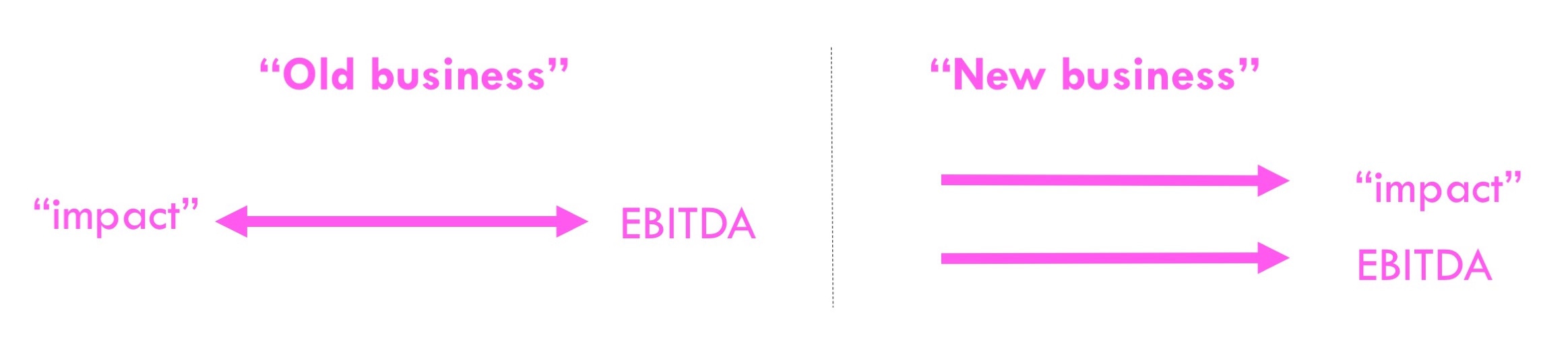
Another example: even the most forward-looking energy companies making the largest investments in renewable solutions typically end up looking grim compared to, say, IT-consulting companies. This is because the value they create and its relevance to our societies are not taken into account. Resources used by companies should always be compared to values created with them.
So what could work better?
When I first heard about the Upright Project, it was like sunshine after a rainy season. Upright has been created by two young, but highly experienced entrepreneurs — Annu Nieminen with a management consulting background and Juho Ojala with technology development and machine learning expertise. They wanted to create a framework encouraging companies to improve and optimize their overall net impact from a factual and scientific basis.
I very much respected the perfect marriage of their uncompromising scientific approach with a genuine desire to help humankind to solve some of the existential challenges we face. Let me explain what Upright does.
How the model works
Upright is building a new type of quantification model to measure the net impact of companies on the environment, health of people, society and knowledge. The aim is to identify both the resources used as well as value created by companies, and to measure the net sum of these costs and gains. As primary data source, Upright's model utilizes the world's largest open-access database for scientific articles, CORE. With natural language processing technologies, the model automates the process of summarizing findings of scientific research and attributing them to products and companies.
As an example, the latest research on microplastics is automatically taken into account for companies that utilize plastic in their products. For those companies that arrange collection and reuse of the plastic they use in their products, that is automatically taken into account as long as the company describes their recycling practises on their website.
At the core of Upright's model is a graph of all products and services currently traded in global markets. The graph understands value chain relations between products and allocates production, monetary and impact flows across value chains. The negatives and positives are distributed in the value chain eliminating double counting (same positives and/or negatives being counted twice by two or more operators). You can read more about the Upright model here.
Management and boards, this is also for you
Upright does not aim to divide companies into "good" and "bad" ones, but to shed light to the trade-offs and assumptions made across impact categories in everyday decision-making by managers, investors, consumers and owners. That's why the weights across different impacts are not fixed. The user of the model defines them as their optimization criteria.
Upright is not just a tool for investors, it is very much something management teams have lacked. It enables competing companies to compare themselves not only based on their historical financial results, but also on their overall net impact. Upright assists management in measuring their progress in improving the company’s net impact, setting objectives and communicating results to their stakeholders. I also expect boards of directors to start paying more attention on the net impact of their business in the way they monitor and set objectives. You can see an example of a company score here.
Upright also works with companies to ensure the model has the right parameters and the values are up to date. Anyone can contribute online and inform about missing or inaccurate information, citing a relevant source.
Why I wanted to join
As I heard about Upright I wanted to learn more about how their model works. We had a number of meetings where I was able to satisfy my curiosity and perhaps also able to offer some advice to Annu and Juho. After more than a year of occasional joint brainstorming, Annu asked me if I would be willing to have a deeper involvement with Upright and become a shareholder.
I did not need to think twice. What Upright is trying to create is a platform technology that can help all businesses become a better business. This is not just a worthwhile objective, it is also technically an extremely complex challenge. If this perfect combination of helping the world and tackling a really big and hairy execution challenge does not deserve support, then I do not know what would.
You can explore real profiles with Upright's public search. If you have any questions, please don’t hesitate to get in touch with us via email to hello@uprightproject.com.
October 22, 2019
Risto Siilasmaa
Chairman, Nokia and F-Secure & Advisor and investor, Upright
Share: