Measuring impact
Data insights: “The Best Companies of 2023” ranking by Time highlights a dire need to rethink corporate excellence
Is developing software with low emissions truly what the best companies do? We analyzed top companies on Time Magazine's “The World's Best Companies of 2023” list to find out how they actually impact the world. Here are three key insights – all of them pretty bleak.
Published Jan 12, 2024
Can you define “the best” companies in the world simply by looking at revenue growth, employee satisfaction, and ESG metrics?
This is what Time Magazine, in collaboration with the data platform Statista, did in late 2023 to rank the 750 “Best Companies of 2023”. The ranked companies and other media alike joined to celebrate the top-performers.
We analyzed the companies for their science-based net impact, which captures companies’ positive and negative impacts on the environment, society, human health and knowledge creation.
The takeaway? It might be time for Time to re-evaluate what “the best” looks like in business.
Here are our three key insights:
1. The top 10 is mostly tech giants – and they are not that “good” for the world
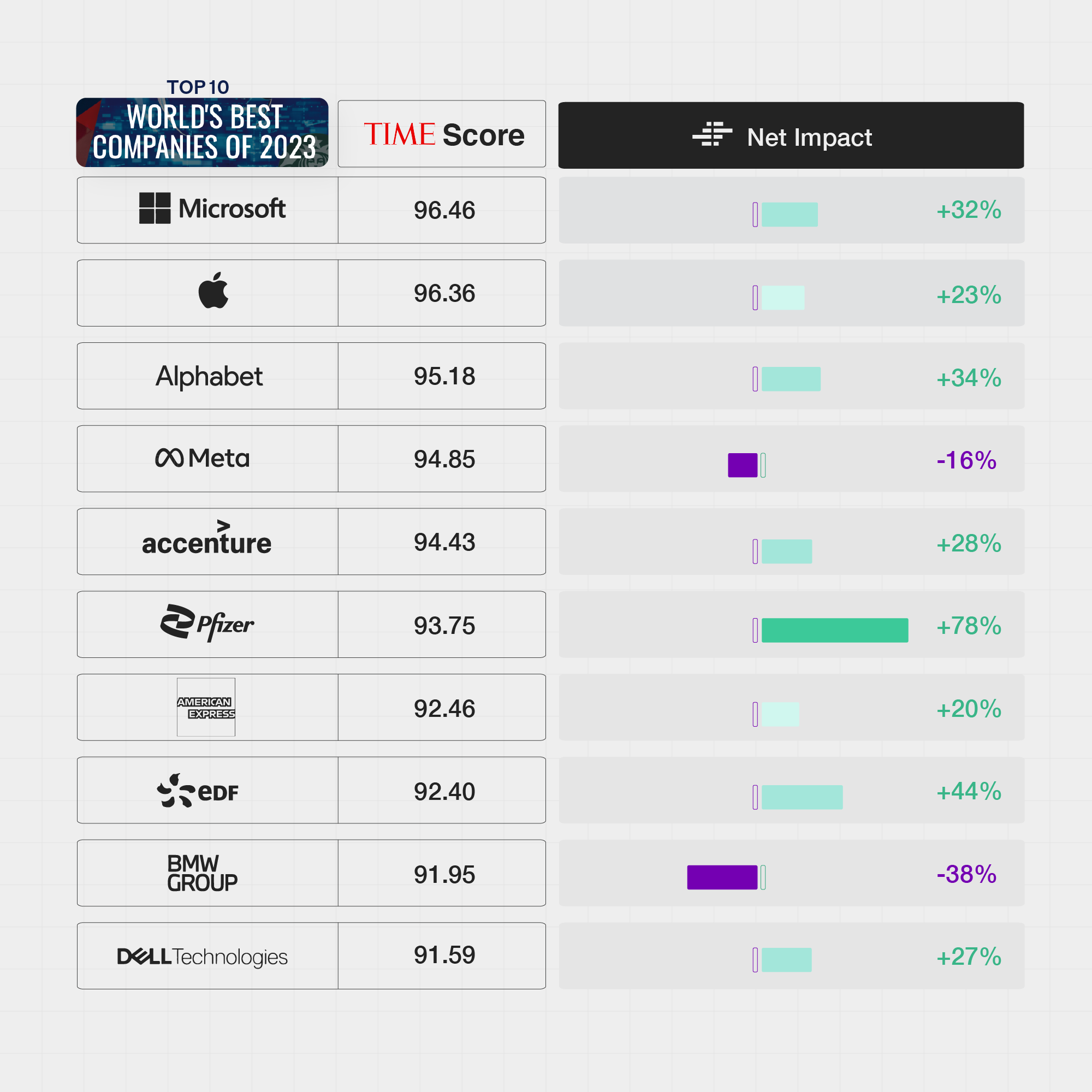
The top 10 of the “best” companies includes e.g. multiple technology giants, as well as professional and financial services providers.
While Microsoft, Apple, Alphabet (Google), and Meta (Facebook) claimed the top four spots as the “best companies in the world” by Time, their net impact reveals a different narrative.
Take Meta for an example: Even though Meta doesn't bring massive environmental costs to the world, it does have large negative impacts e.g. on physical and mental health. And currently, Meta's positive impacts from i.e. paying taxes and contributing to relationships are not enough to compensate for the costs it creates.
As for consumer tech companies like Apple, there are also massive negative GHG emissions and waste impacts at play.
In sum, digital doesn't automatically translate into “good for the world,” and when it comes to solving the world's biggest problems, big tech, banks, or consultants certainly don't top that ranking.
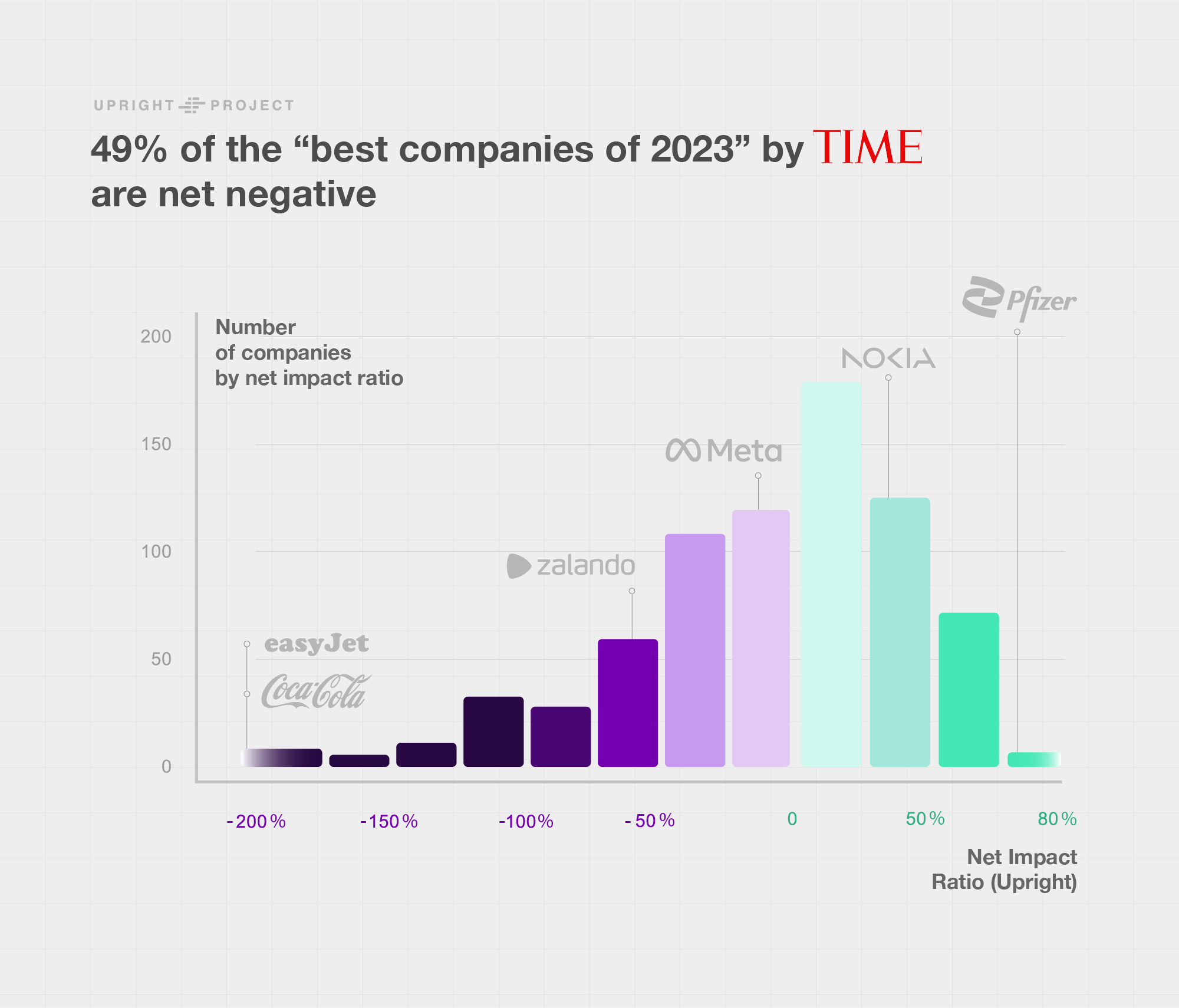
2. 49% of “the best” companies bring more costs than benefits to the world
A whopping 49% of the top 750 companies bring more costs than benefits to the world. Fossil fuel giants such as China Petrochemical Corp, Saudi Aramco, Exxon Mobil, and Shell are prominent on the list, prioritizing investor interests over global welfare.
Additionally, companies like Coca-Cola, Pepsi, and even gaming entities make the list, despite their burden on human health.
Many companies contributing to lifestyle choices at the expense of the environment, like budget airline companies easyJet and RyanAir, as well as luxury fashion brands like Prada, LVMH Moet Hennessy, and Chanel, also make the list.
Finally, filtering the list according to Time's “sustainability” rank, Zalando is number 12 – an intriguing placement for a fast fashion retailer.
3. A tiny fraction of “the best” companies actively mitigate climate change
How are the “the best” companies' contributions to climate change? Quite underwhelming:
- Less than 9% of the companies have over 10% of their revenue aligned with the UN’s Sustainable Development Goal number 13, Climate Action.
- A whopping 20% of companies have more than 10% of their revenue misaligned with the goal.
- Less than 1% of the companies have more than half of their revenue aligned with the Climate Action SDG, while over 6% have more than half of their revenue misaligned.
When looking at the top ranking companies through the EU Taxonomy – the EU's classification system established to clarify which economic activities are environmentally sustainable – the results don't look much better:
Only 2% have over 50% of their revenue aligned with the EU Taxonomy, meaning that 98% of the companies have more than half of their revenue coming from unsustainable activities as defined by the EU.
It's time to rethink corporate excellent in terms of impact
As media powerhouses like Time continue to shape perceptions of corporate excellence, it becomes clear that in 2024, it's time to reassess the criteria.
Of course, it's harder to evaluate companies based on their actual impact on the world rather than simple, conventional metrics like employee satisfaction, financial performance, and ESG compliance. Nevertheless, quantifying impact is the only way forward.
What the world needs is not more hyper-growth companies that are fun employers and good at ESG compliance, but companies that manage to optimize resource use for benefits for people and the planet.
January 12th, 2024
Upright Project
Share: