Big ideas
Why does the ridiculously ambitious, borderline “impossible” Upright impact model exist?
Companies and investment funds are facing a challenge unforeseen in modern capitalism: they need to justify their existence by explaining *what else* they bring to the world beyond shareholder value. For this, they need to convince their stakeholders of the holistic value created by their core business – a task that requires understanding of complex flows of value across the global economy.
Annu Nieminen
CEO & Founder, Upright Project
Published Apr 25, 2024
Let’s start by admitting facts: the Upright net impact model is complex and hard to understand.
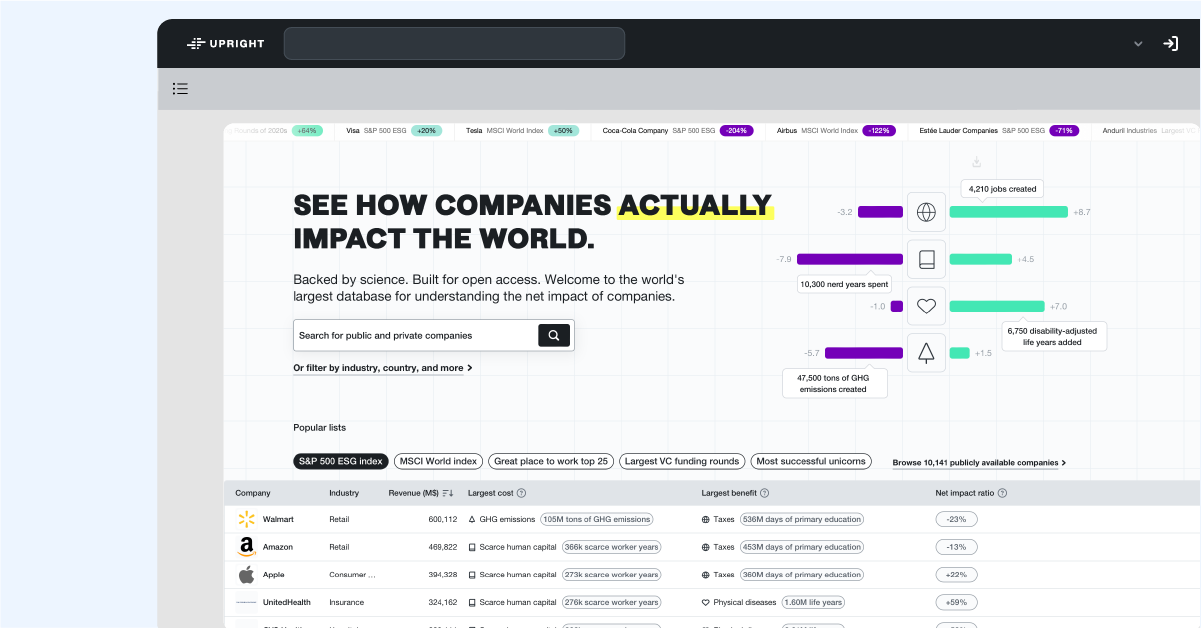
In short, we have built a model that aims to quantify the impact of everything on everything – and do it so that no double-counting occurs. This means that the Upright net impact model simulates the world’s impact flows in a way where each unit of “impact” – be it emissions, waste, health outcomes, tax dollars, or something else – is allocated once and only once.
We feed the model with huge amounts of information, including the world’s largest open-access database of scientific publications, and ask it to determine an answer to an overwhelming question: how much societal, environmental, and health value does each company create and destroy. This means modelling not just all the production flows and value chain dynamics across the global private sector, but also how various impacts are born in each node.
We admit it: this is complex, and we struggle daily to explain it clearly enough.
At the same time, we solemnly believe adopting the thinking logic behind this complex data model can actually save company executives and investors significant time, money – and yes, eventually their business. This is because it brings to focus the real transformation happening behind today’s increasingly noisy sustainability discussion. But this transformation is so vast, it almost cannot be seen.
This transformation is so vast, it almost cannot be seen.
So what can be seen? Lots of new sustainability-related reporting requirements for companies and funds. Marketing arguments based on sustainability claims. PR crises for greenwashing over said claims. Hundreds of conferences, clubs, and pledges to sign, join, and celebrate.
But none of this is really the root of what is happening. New reporting requirements are not the thing. Marketing trends are not the thing. These are business world phenomena that come and go.
The real, groundbreaking, and existential transformation that is almost too big to be seen is something else: The ground rules for running a business or an investment fund are fundamentally changing.
As of the 2020s, all companies, regardless of industry, size, or business model, will need to justify their existence by more than shareholder value only. They are asked a mind-boggling question: Why do they exist? How do they convince their employees, investors, and customers that they use their resources in a sensible way, that they create more value than they destroy?
Creating shareholder value is no longer enough, as more and more stakeholders – asset owners, consumers, talent, regulators – have started to vote with their questions, demands, money, and power. They ask: How do you make sure your process of creating shareholder value does not destroy more value somewhere else?
How do you make sure your process of creating shareholder value does not destroy more value somewhere else?
This means that companies will need to explain, in a transparent way that respects their stakeholders’ intelligence and hunger for knowledge, how they really create value: what resources they employ, and how they turn them into different types of value. Not just shareholder value, but also jobs, taxes, health outcomes, new knowledge, saved emissions, reversed biodiversity loss, lessened societal polarisation and violence, you name it.
Does this mean another report? No. This cannot be done by just another report by the company where anecdotal facts around the area are disclosed. Stakeholders will not be happy with a list of “these are the things we think are material” (a fancy word for significant) or strategy statements of things the company “holds as central values.”
Addressing this new challenge requires a humble data exercise, where each company is treated the same way as others. Analysed under the same assumptions, scrutinised over the same impact categories. The crucial question asked is: How do all these companies together cause the global impacts we witness – be it CO2 emissions, biodiversity loss, plastics in the oceans, tobacco-related lung diseases, overweight populations, fake news? What is each company’s share of all of this?
The complex, impossible Upright model aims to measure exactly this: how real-life companies and funds fit into this complicated web of value streams. In practice, we have built a way of allocating 100% of any global impact into the strongly interrelated network of products and services that form the global economy.
For example, the Upright model takes the total of CO2e emissions that the IPCC estimates to be caused by the global private sector annually and allocates it through the whole network of products, considering value chain relations between companies and production volumes flowing from each node to another. And then repeats this for altogether 31 different impact categories. This way, we can produce an estimation of what kind of a role each company plays in causing the various positive and negative impacts born in the global economy.
What is each company’s share of the global CO2? What about waste, jobs, health outcomes?
Coming back to the initial claim: how can this overwhelming data save a business?
Simply: by keeping it honest. At the end of the day, the companies that will come out as winners in the new paradigm are ones that asked the inconvenient questions about the holistic impact of their existence before their stakeholders did. They took a brutally honest look in the mirror before others started to X-ray them for them. They based their new strategic narratives on facts, not daydreams or serious undermining of their stakeholders’ intelligence.
And those shareholders? They will not really care about the number of sustainability related awards your company wins this year or the length of your new report. They care about how the new demands by your investors, staff, customers, and regulators affect your ability to be in business in five years.
More information
April 25th, 2024
Annu Nieminen
CEO & Founder, Upright Project
Share: